What they are, how they differ, and why it matters.
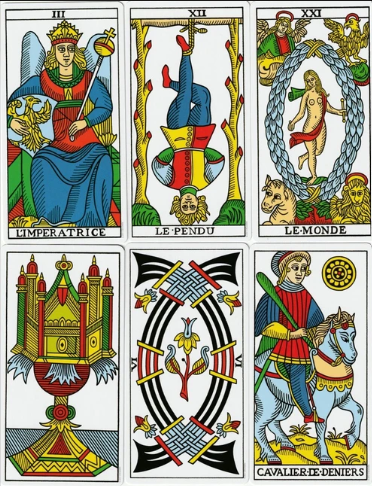
1. The Marseille Tarot (17th–18th Century)
Origin: France, c. 1650–1750 Creators: Anonymous woodblock artists; later standardised by Nicolas Conver (1760) Style: Medieval/Renaissance woodcut Philosophy: Pre-occult, pre-Golden Dawn Use: Divination, fortune-telling, folk magic, numerology
Key Characteristics
- Pip cards are non-illustrated. The Minors show arrangements of suit symbols (e.g., 5 swords, 7 cups) – no scenes, no characters. Interpretation relies on numerology + suit element, not imagery.
- Major Arcana are iconic but simple. Medieval symbolism, Christian motifs, and allegory dominate.
- Colour palette is limited. Primary colours (red, blue, yellow) due to woodblock printing.
- No Golden Dawn influence. Marseille predates modern occult systems.
Reading Style
- Abstract
- Numerological
- Symbolic
- Less psychological, more traditional
Why It Matters
Marseille is the root of modern tarot. RWS and Thoth both evolved from it – but Marseille remains the most “pure” historical tarot.
2. The Thoth Tarot (1940s)
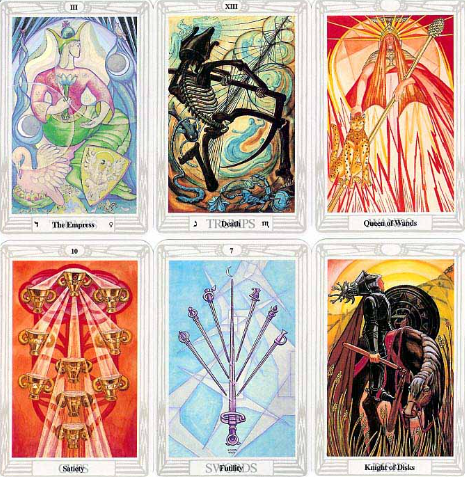
Origin: UK Creators: Aleister Crowley (occultist) & Lady Frieda Harris (artist) Style: Esoteric, symbolic, abstract, visionary Philosophy: Hermetic Qabalah, Thelema, astrology, alchemy Use: Deep occult work, psychological exploration, ceremonial magic
Key Characteristics
- Highly symbolic, densely esoteric imagery. Every card is layered with Qabalistic, astrological, and alchemical symbols.
- Pip cards are semi-illustrated. Not scenes like RWS, but symbolic compositions (e.g., “Strife”, “Victory”, “Debauch”).
- Renamed Major Arcana:
- Strength → Lust
- Temperance → Art
- Judgement → Aeon
- The Universe replaces The World
- Astrology is explicit. Symbols appear directly on the cards.
- Colour theory is magical. Harris used Golden Dawn colour scales to encode elemental and planetary energies.
Reading Style
- Psychological
- Archetypal
- Mystical
- Intense, transformative
- Less literal, more energetic
Why It Matters
Thoth is the deep occult deck – a spiritual system disguised as tarot.
3. The Rider–Waite–Smith Tarot (1909)
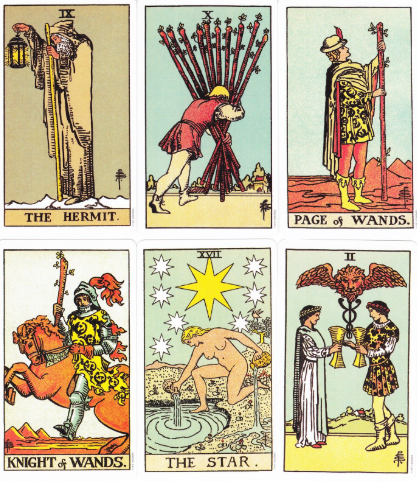
Origin: UK Creators: A.E. Waite & Pamela Colman Smith Style: Narrative, symbolic, accessible Philosophy: Golden Dawn, Christian mysticism, theatre symbolism Use: Intuitive reading, psychological insight, modern tarot practice
Key Characteristics
- Fully illustrated Minor Arcana. This was revolutionary – it made tarot accessible and intuitive.
- Symbolism is layered but readable. Colour, gesture, landscape, animals, architecture.
- Golden Dawn correspondences are embedded but subtle. Unlike Thoth, they are not printed directly on the cards.
Reading Style
- Intuitive
- Narrative
- Psychological
- Accessible
- Emotionally expressive
Why It Matters
RWS is the modern standard – the deck most readers learn first.
4. The Core Differences (The Quick Comparison)
| Feature | Marseille | RWS | Thoth |
|---|---|---|---|
| Era | 17th–18th c. | 1909 | 1940s |
| Minors | Non-illustrated | Fully illustrated | Semi-illustrated |
| Philosophy | Folk, Christian allegory | Golden Dawn + mysticism | Golden Dawn + Thelema + Qabalah |
| Reading Style | Numerological | Intuitive | Esoteric |
| Art Style | Woodcut | Narrative illustration | Abstract, symbolic |
| Astrology | None | Hidden | Explicit |
| Best For | Traditionalists | Most readers | Occultists |
5. How They Relate to Each Other
- Marseille is the ancestor.
- RWS is the accessible modernisation.
- Thoth is the occult deep dive.
All three are legitimate systems – they simply serve different purposes.
6. Which Deck Is Best for What?
Marseille
- Historical study
- Numerology
- Minimalist symbolism
- Traditional fortune-telling
RWS
- Intuitive reading
- Emotional and psychological insight
- Teaching beginners
- Modern tarot practice
Thoth
- Qabalah
- Astrology
- Shadow work
- Deep spiritual transformation