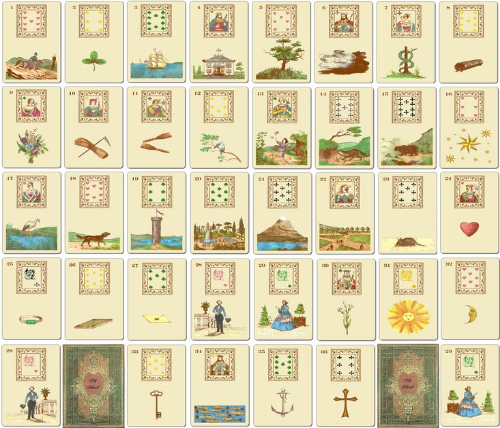
Lenormand cards are a 36-card European divination system built for clarity, speed, and practical answers. They’re direct, symbolic, and read in combinations – more like forming sentences than interpreting archetypes. They originated from an 18th-century German board game and were later named after the famous French cartomancer Marie Anne Lenormand, though she never used this deck.
Each card includes:
- A number (1–36)
- A symbol (always a noun/object)
- A playing-card inset (a holdover from its origins)
Lenormand is:
- Literal (a house means home; a ship means travel)
- Combination-based (cards modify each other)
- Practical (relationships, work, daily life)
- Fast (answers often read like short sentences)
Historical Origins
1. The Game of Hope (1799)
The earliest Lenormand deck comes from Das Spiel der Hoffnung (“The Game of Hope”), created by Johann Kaspar Hechtel in 1799. It was a parlour board game using 36 illustrated cards – the same images used in Lenormand today.
2. Marie Anne Lenormand (1772–1843)
A famous French fortuneteller who read for Empress Joséphine and Napoleon. Her name was attached to the deck after her death as a marketing strategy. She did not design or use the 36-card system.
3. 19th-Century German Cartomancy
German publishers repurposed the Game of Hope cards into a divination deck in the 1840s. By the late 19th century, Lenormand was widely used across German-speaking Europe.
Structure of the Deck
Lenormand’s 36 cards are fixed in order:
- 1 Rider – News, arrival, movement
- 2 Clover – Luck, opportunity, small blessing
- 3 Ship – Travel, distance, exploration
- 4 House – Home, family, stability
- 5 Tree – Health, growth, long-term development
- 6 Clouds – Confusion, uncertainty, doubt
- 7 Snake – Deception, manipulation, complications
- 8 Coffin – Ending, closure, transformation
- 9 Bouquet – Gift, beauty, appreciation
- 10 Scythe – Sudden cut, shock, decisive action
- 11 Whip – Conflict, tension, repetitive issues
- 12 Birds – Conversation, discussion, nervous energy
- 13 Child – New beginning, innocence, something small
- 14 Fox – Trickery, work, cunning
- 15 Bear – Strength, authority, finances
- 16 Stars – Guidance, clarity, inspiration
- 17 Stork – Change, improvement, transition
- 18 Dog – Loyalty, friendship, support
- 19 Tower – Institutions, authority, isolation
- 20 Garden – Social sphere, community, public events
- 21 Mountain – Block, obstacle, delay
- 22 Crossroads – Choice, decision, options
- 23 Mice – Loss, stress, erosion
- 24 Heart – Love, affection, emotional matters
- 25 Ring – Commitment, contract, agreement
- 26 Book – Secrets, knowledge, hidden information
- 27 Letter – Written communication, documents
- 28 Man – Male significator
- 29 Woman – Female significator
- 30 Lily – Peace, maturity, sexuality
- 31 Sun – Success, vitality, positivity
- 32 Moon – Recognition, creativity, emotions
- 33 Key – Solution, breakthrough, certainty
- 34 Fish – Money, business, flow
- 35 Anchor – Stability, endurance, long-term
- 36 Cross – Burden, suffering, fate
How Lenormand Is Read
Lenormand is not read like Tarot. It uses combinations, direction, and proximity.
1. Combination Reading
Cards form “sentences.” Example: Ship + Ring + Heart → a romantic relationship involving travel or distance.
2. Literal Interpretation
Symbols mean what they show – no archetypal layers. House = home. Tree = health. Key = solution.
3. Timing
Rider = fast Tree = slow Stork = soon Cross = fated/inevitable
4. People Cards
Man/Woman act as significators. Other cards can describe personality types (Fox = cunning, Dog = loyal).
5. Directional Reading
In the Grand Tableau, cards to the left = past; right = future; above = external; below = internal.
Why Lenormand Feels Different from Tarot or Kipper
Lenormand vs Tarot
- Tarot = archetypes, psychology, spiritual lessons
- Lenormand = nouns + verbs, literal events
- Tarot = one card can answer a question
- Lenormand = cards must be combined
- Tarot = symbolic depth
- Lenormand = practical clarity
Lenormand vs Kipper
- Kipper = people + social scenes
- Lenormand = objects + symbols
- Kipper = narrative drama
- Lenormand = symbolic grammar
- Kipper = interpersonal clarity
- Lenormand = situational clarity
What Lenormand Is Best For
- Daily guidance
- Relationship dynamics
- Work and career
- Money and practical decisions
- Timing questions
- “What’s happening?” clarity
- Grand Tableau life mapping