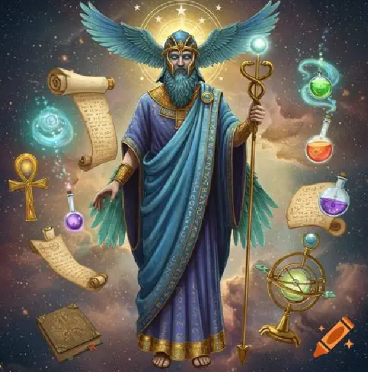
One of the most influential figures in Western esoteric history, he is a mythic composite of the Greek god Hermes, and the Egyptian God Thoth.
Hermes Trismegistus (“Hermes the Thrice-Great”) is a legendary Hellenistic figure, not a single historical person. He emerged when Greek and Egyptian cultures blended in Ptolemaic Egypt, merging:
- Hermes – Greek god of communication, interpretation, and knowledge
- Thoth – Egyptian god of writing, wisdom, magic, and measurement
Greeks identified Thoth with Hermes (interpretatio graeca), and the two became worshipped as one deity in Hermopolis, the former Temple of Thoth.
Hermes Trismegistus became the symbolic author of the Hermetica – philosophical, mystical, and alchemical texts foundational to Hermeticism.
Hermes Trismegistus is credited with a body of writings known as the Hermetica, including:
- Corpus Hermeticum
- Poimandres
- Asclepius
- Definitions of Hermes Trismegistus
- Liber Hermetis (astrological)
- The Emerald Tablet (Tabula Smaragdina)
These texts explore:
- The nature of the cosmos
- The relationship between the divine and the material
- The soul’s ascent
- Magic, astrology, and alchemy
- The unity of all things
They were central to medieval Islamic esotericism and later Renaissance philosophy.
Hermes Trismegistus influenced:
1. Alchemy
The Emerald Tablet became the foundation of Western alchemical theory, especially the idea of transformation and the philosopher’s stone.
2. Renaissance Philosophy
Thinkers like Ficino, Pico della Mirandola, and Giordano Bruno saw Hermeticism as a pure, ancient theology.
3. Esoteric Orders
Hermeticism shaped:
- Rosicrucianism
- Hermetic Order of the Golden Dawn
- Modern ceremonial magic
- The Kybalion
- Occult Qabalah
4. Psychology
Carl Jung interpreted the Emerald Tablet as a symbolic map of psychological transformation.
5. Modern Spirituality
“As above, so below” remains one of the most widely used metaphysical principles.