Atlantis is a legendary island described by Plato – not a confirmed historical civilization – and its entire meaning comes from philosophy, moral allegory, and later cultural reinterpretation.
What Atlantis Actually Is (According to Plato)
Atlantis appears only in two works by Plato: Timaeus and Critias. Plato presents it as a fictional naval empire used to illustrate the dangers of hubris, moral decline, and the superiority of the ideal state.
Key elements from Plato:
- A powerful island “beyond the Pillars of Hercules” (Strait of Gibraltar).
- Ruled by Poseidon’s descendants, especially Atlas.
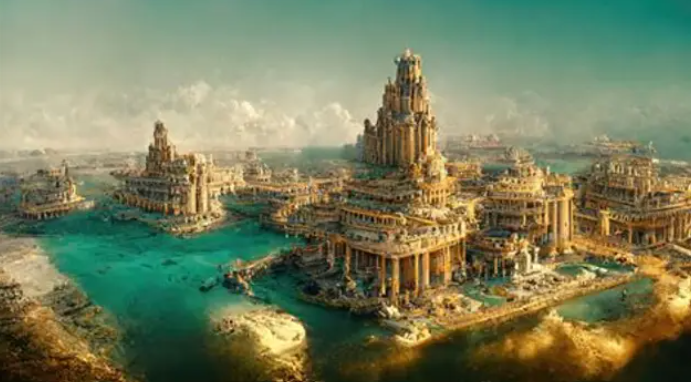
- Structured in concentric rings of land and water.
- Initially virtuous, wealthy, and advanced.
- Became corrupt, sought conquest, and attacked a proto-Athens.
- Lost divine favour and sank into the sea after earthquakes and floods.
Plato’s purpose was philosophical, not historical: He used Atlantis as a moral allegory about the fall of nations that abandon virtue.
Origins of the Story
Plato claims the story came from Egyptian priests via Solon, but this is part of the narrative device. He places the events 9,000 years before Solon, which historians view as symbolic rather than literal.
Modern scholarship agrees: Atlantis is fictional, created to contrast Athens with a decadent imperial power.
Description of Atlantis (Plato’s Details)
Geography & Layout
- Larger than Libya and Asia Minor combined.
- Concentric rings of land and sea engineered by Poseidon.
- Fertile land, hot and cold springs, rich mines.
Society
- Ten kings descended from Poseidon’s sons.
- Strict moral code in early generations.
- Advanced engineering, agriculture, and naval power.
Downfall
- Moral corruption → imperial aggression → divine punishment.
- Earthquakes and floods → island sinks “in a single day and night.”
Why Atlantis Became a Cultural Obsession
Although minor in Plato’s work, Atlantis became a major cultural myth due to:
1. Renaissance Utopias
Writers like Francis Bacon (New Atlantis) used the idea to explore ideal societies.
2. 19th-Century Pseudoscience
Ignatius Donnelly’s Atlantis: The Antediluvian World claimed it was a real lost civilization, sparking modern speculation.
3. Theosophy & Occult Movements
Blavatsky and later occultists linked Atlantis to mystical races and ancient wisdom.
4. Modern Popular Culture
Atlantis appears in films, novels, games, and conspiracy theories – often as a technologically advanced utopia.
What Atlantis Means (Symbolically)
Atlantis is fundamentally a lesson:
- Virtue → prosperity
- Corruption → downfall
- Hubris → destruction
Plato used Atlantis to illustrate:
- the fragility of empires
- the moral responsibilities of rulers
- the superiority of the ideal state (Athens in his philosophy)
In One Sentence
Atlantis is a philosophical myth created by Plato – a story of a powerful island empire that rose in virtue, fell into corruption, and was destroyed by the gods – later transformed into a global legend of lost civilizations.